
The frozen food sector has transformed significantly over the last decade. What was once limited to basic frozen vegetables and ready-to-cook snacks has evolved into a massive category that includes gourmet meals, frozen meats, desserts, seafood, bakery products, plant-based alternatives, and convenience foods. As consumer demand continues growing, businesses are under increasing pressure to maintain freshness, hygiene, shelf life, and product presentation throughout the supply chain.
This rapid expansion has also increased the importance of advanced packaging systems. In today’s highly competitive frozen food packaging market, packaging is no longer just about storing products. It has become a critical part of product protection, transportation efficiency, freezer durability, branding, and customer experience.
At Arceus India, one of the most noticeable shifts in recent years has been the growing demand for automated packaging systems specifically designed for frozen food applications. Businesses are moving away from conventional packaging setups and investing in specialised solutions that can handle low temperatures, moisture control, and high-speed production without compromising packaging quality.
Understanding the challenges within the frozen food packaging industry helps explain why modern packaging technology has become essential for scaling frozen food operations successfully.
The Growing Demand in the Frozen Food Packaging Market
The global frozen food packaging market has expanded rapidly due to changing lifestyles, urbanisation, and increasing demand for convenient meal solutions. Consumers today expect frozen products to maintain the same taste, texture, and quality as fresh alternatives, even after long storage periods.
This expectation places enormous pressure on manufacturers. Frozen products experience constant exposure to moisture, extreme temperatures, transportation movement, and freezer storage conditions. Without proper packaging systems, products can suffer from freezer burn, leakage, contamination, damaged seals, or texture deterioration.
As a result, the frozen food packaging industry has become increasingly technology-driven. Businesses are now prioritising packaging materials and machinery capable of maintaining structural integrity in cold environments while also supporting faster production speeds and improved product consistency.
Packaging also plays a significant role in retail performance. Consumers often judge frozen products based on packaging appearance, seal quality, and product visibility. Poorly sealed or damaged packaging immediately affects customer trust, regardless of the product inside.
Why Packaging of Frozen Products Requires Specialised Solutions
The packaging of frozen products is far more complex than standard dry-food packaging. Frozen items create unique operational challenges because packaging materials behave differently under low-temperature conditions.
For example, certain films become brittle in freezing environments, increasing the risk of cracks or punctures during transportation. Moisture accumulation can weaken seals if machines are not calibrated correctly. Condensation may also interfere with label adhesion and packaging aesthetics.
Another major challenge in the packaging of frozen products is maintaining airtight sealing. Frozen foods are highly vulnerable to air exposure, which can lead to oxidation, dehydration, and freezer burn. Even minor sealing inconsistencies can reduce shelf life and compromise product quality.
This is why frozen food manufacturers increasingly rely on advanced automation systems designed specifically for temperature-sensitive production environments. Machines handling frozen packaging applications must maintain consistent sealing pressure, accurate filling, and stable operational performance despite cold conditions and continuous production cycles.
How Automation Is Transforming the Frozen Food Packaging Industry
Automation is now reshaping the entire frozen food packaging industry. High-speed packaging systems allow manufacturers to handle larger production volumes while maintaining consistency and reducing human intervention.
Traditional manual packaging methods often struggle in frozen production environments because low temperatures slow handling efficiency and increase contamination risks. Automated systems solve these issues by improving precision, reducing direct product handling, and maintaining controlled packaging processes.
Modern packaging systems are capable of handling various frozen products including vegetables, seafood, chicken, ready meals, frozen snacks, and desserts. These systems can integrate weighing, filling, sealing, coding, and conveyor automation into a single production line.
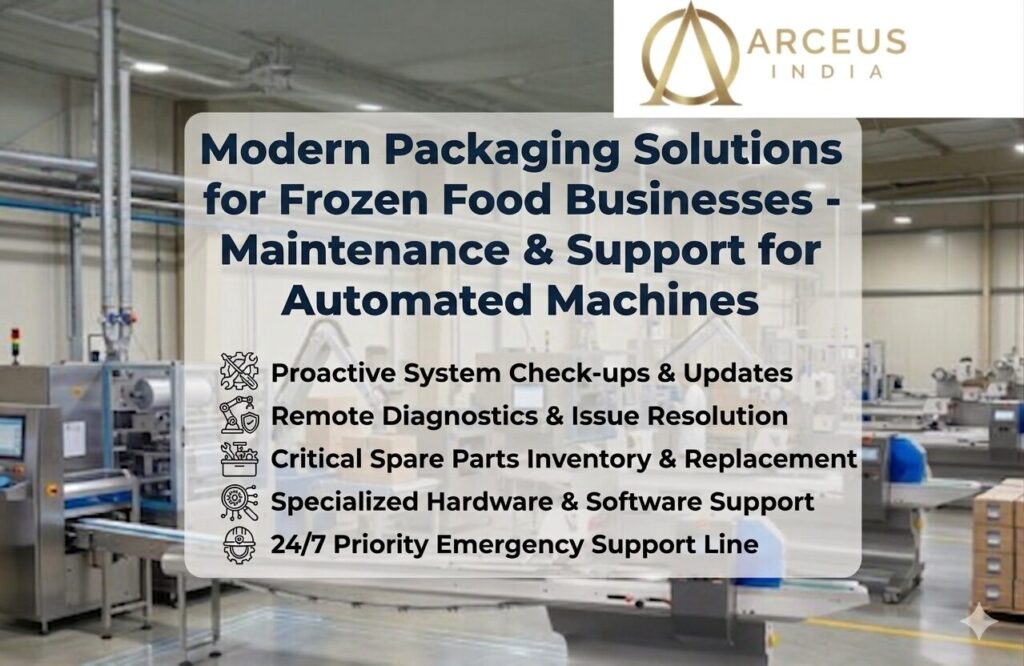
At a practical level, automation also improves operational reliability. Many businesses underestimate how difficult frozen production conditions can be on machinery. Moisture exposure, condensation, and continuous cold operation place additional stress on moving components and sealing systems. Advanced automation equipment is specifically engineered to withstand these demanding conditions.
At one stage, Arceus India observed facilities where older sealing systems struggled to maintain packaging consistency during high-volume frozen snack production. Once upgraded packaging systems were introduced, sealing stability improved substantially, material wastage decreased, and downtime became significantly lower during peak production hours.
This demonstrates why businesses in the frozen food packaging market are increasingly investing in modern packaging infrastructure instead of relying on outdated equipment.
The Importance of Packaging Integrity in Frozen Foods
Packaging integrity is one of the most critical factors in frozen food operations. Even small packaging defects can result in large-scale inventory losses.
In the packaging of frozen products, strong seals help prevent moisture penetration, preserve texture, and maintain product freshness over extended storage periods. Weak seals or damaged packaging often allow air infiltration, leading to ice crystal formation and freezer burn.
Temperature fluctuations during transportation also make packaging durability extremely important. Frozen products may move through warehouses, refrigerated trucks, distribution centres, and retail freezers before reaching consumers. Packaging must withstand these transitions without tearing, leaking, or losing structural strength.
Modern flexible packaging materials are increasingly being used in the frozen food packaging industry because they provide strong moisture barriers while also supporting attractive product presentation. Combined with automated sealing systems, these materials help manufacturers maintain consistent packaging performance at scale.
Packaging accuracy also affects operational profitability. Incorrect filling weights, damaged pouches, or inconsistent seals increase product rejection rates and material wastage. High-precision automated systems reduce these issues while improving overall production efficiency.
Frozen Food Packaging Machine Solutions for Modern Manufacturing
Today’s frozen food packaging machine solutions are designed to address both operational efficiency and product protection. These systems combine automation, durability, and precision to support high-volume production environments.
Modern frozen food packaging systems commonly include automatic weighing systems, vertical form-fill-seal machines, multihead weighers, conveyor integrations, nitrogen flushing technology, and high-performance sealing units. Together, these technologies help maintain packaging consistency while supporting faster production speeds.
One of the biggest advantages of advanced frozen food packaging machine solutions is production scalability. As frozen food demand continues increasing, businesses require systems capable of handling larger packaging volumes without compromising quality.
Another important benefit is hygiene control. Frozen food manufacturers must maintain strict food safety standards throughout the packaging process. Automated systems minimise direct handling and reduce contamination risks, helping businesses maintain regulatory compliance more effectively.
Flexibility is also becoming increasingly important in the frozen food packaging market. Manufacturers now produce multiple product formats including pouches, stand-up packs, zipper bags, trays, and family-size packaging. Modern packaging systems are designed to handle these changing packaging requirements with minimal downtime during format transitions.
Sustainability and the Future of Frozen Food Packaging
Sustainability is becoming a major priority across the frozen food packaging industry. Consumers and retailers are demanding packaging solutions that reduce environmental impact while still maintaining freezer durability and product protection.
Manufacturers are exploring recyclable films, lightweight packaging structures, and reduced material consumption without compromising packaging performance. However, frozen food applications remain technically challenging because packaging still needs strong moisture resistance and sealing reliability.
This is pushing the industry toward smarter packaging innovation. Businesses are increasingly combining sustainable materials with advanced automation systems to improve efficiency while reducing operational waste.
The future of the frozen food packaging market will likely focus on balancing sustainability, automation, product protection, and production scalability simultaneously.
Building Reliable Frozen Food Packaging Operations
Success in frozen food manufacturing depends heavily on packaging reliability. As competition increases, businesses cannot afford inconsistent sealing, packaging failures, or production downtime.
Investing in advanced frozen food packaging machine solutions helps manufacturers improve shelf life, reduce wastage, increase operational efficiency, and maintain product quality throughout distribution.
The modern packaging of frozen products requires far more than basic sealing and storage. It demands specialised systems capable of operating efficiently in demanding cold-chain environments while maintaining packaging precision at high production speeds.
Businesses that adapt to these evolving packaging demands are better positioned to scale production, strengthen brand trust, and compete effectively in the rapidly growing frozen food sector.