
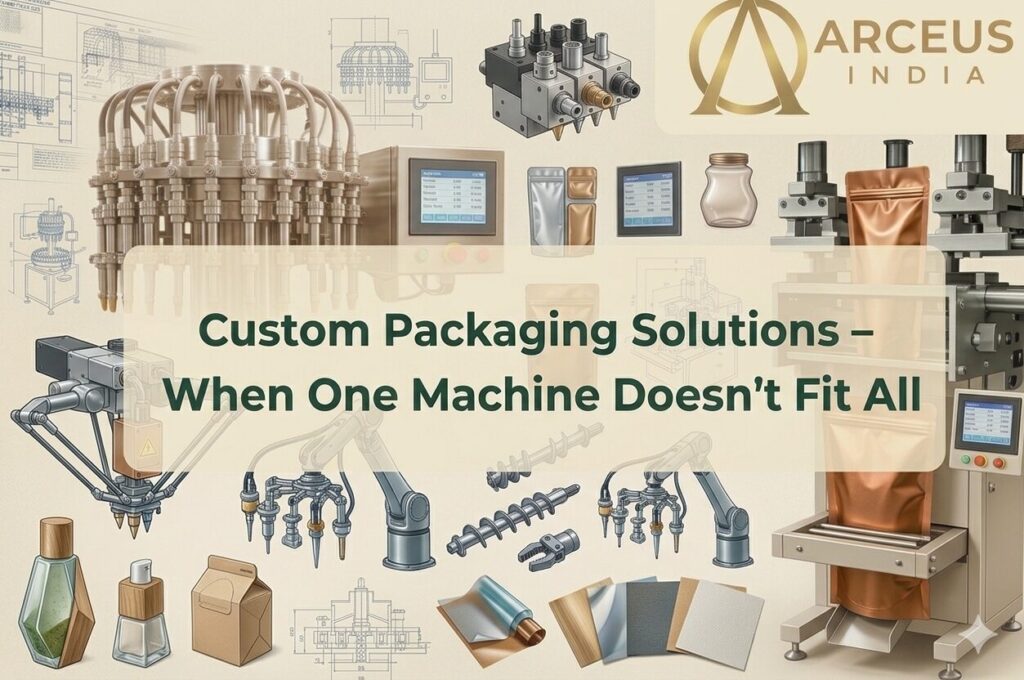
In today’s dynamic manufacturing ecosystem, packaging is no longer a standardised, one-size-fits-all process. With products becoming more diverse and consumer expectations rising, businesses are increasingly shifting towards tailored systems that align with specific operational needs. This is where the concept of custom packaging meaning becomes highly relevant. Instead of forcing products to adapt to machines, modern manufacturing focuses on designing machines around the product. At Arceus India, this approach is central to delivering packaging solutions that are precise, scalable, and built for real-world production challenges.
What is Custom Packaging and Why It Matters
To fully understand the shift, it is important to define what is custom packaging. Custom packaging refers to the design and implementation of packaging systems that are specifically engineered to suit a particular product, rather than relying on generic machinery. This includes customising the machine design, filling mechanism, sealing technology, and even packaging materials.
The importance of custom packaging meaning lies in its ability to address product-specific challenges. Whether it is handling fragile items, sticky substances, irregular shapes, or high-speed production demands, a customized packaging solution ensures that every aspect of the packaging process is optimised. This not only improves efficiency but also enhances product quality and reduces operational risks.
The Limitations of Standard Packaging Machines
Traditional packaging systems are often designed for uniformity, which makes them suitable for mass production of similar products. However, in modern industries where product variations are common, these machines can quickly become restrictive.
A standard machine may struggle with variations in product size, texture, or weight. For example, a machine designed for free-flowing granules may not perform efficiently with sticky powders or viscous materials. This mismatch leads to inefficiencies, increased downtime, and product wastage.
This is precisely why the custom packaging market is growing rapidly. Businesses are realising that adapting machinery to product requirements is far more effective than forcing products to fit into rigid systems.
Industry-Specific Applications of Custom Packaging
The demand for tailored solutions is evident across multiple industries. In the food sector, products range from powders and grains to liquids and semi-solids, each requiring different handling techniques. Custom machines ensure that these variations are managed efficiently without compromising on speed or quality.
In pharmaceuticals, precision and hygiene are paramount. Packaging systems must comply with strict regulatory standards while maintaining accuracy in dosage and sealing. A customized packaging solution ensures that these requirements are met consistently.
The FMCG sector also heavily relies on custom packaging to differentiate products in a competitive market. Unique packaging formats, innovative designs, and efficient production lines are all driven by the growing custom packaging market.
Machinery Innovations Driving Custom Packaging
Advancements in technology have significantly contributed to the growth of the custom packaging market. Modern machines are equipped with smart sensors, real-time monitoring systems, and automated controls that allow for precise adjustments during operation.
These innovations make it possible to design machines that can handle multiple product types without compromising efficiency. For instance, adjustable filling systems can switch between different product viscosities, while intelligent sealing mechanisms ensure consistent results across various packaging materials.
At this stage, Arceus India plays a crucial role by integrating these advanced technologies into customised solutions, enabling businesses to achieve higher productivity and reliability.
Cost vs Value – Is Custom Packaging Worth It?
One of the most common concerns regarding customized packaging solution is the initial investment. Custom systems often require higher upfront costs compared to standard machines. However, this investment must be evaluated in terms of long-term value.
Custom packaging reduces wastage, minimises errors, and improves operational efficiency. It also reduces the need for frequent machine replacements or modifications, leading to significant cost savings over time.
From a strategic perspective, investing in custom packaging allows businesses to stay competitive in a rapidly evolving market. This is one of the key drivers behind the expansion of the custom packaging market.
Integration with Existing Production Lines
Another important aspect of what is custom packaging is its ability to integrate seamlessly with existing production systems. Custom machines are designed to fit into current workflows without causing disruptions.
This includes synchronising with upstream and downstream processes, ensuring smooth material flow, and maintaining consistent production speeds. Proper integration not only enhances efficiency but also reduces downtime and operational complexity.
Sustainability and Custom Packaging
Sustainability has become a major focus in modern manufacturing, and custom packaging plays a significant role in achieving environmental goals. By designing systems that optimise material usage and reduce waste, businesses can minimise their environmental impact.
Custom solutions also enable the use of eco-friendly packaging materials, which may not be compatible with standard machines. This flexibility aligns with the growing demand for sustainable practices within the custom packaging market.
The Future of Custom Packaging Solutions
As industries continue to evolve, the importance of custom packaging meaning will only increase. Businesses are moving towards more personalised, efficient, and sustainable production systems, making custom packaging a key component of future manufacturing strategies.
The integration of AI, machine learning, and IoT will further enhance the capabilities of custom packaging systems, allowing for real-time optimisation and predictive maintenance. This will not only improve efficiency but also reduce operational risks.