
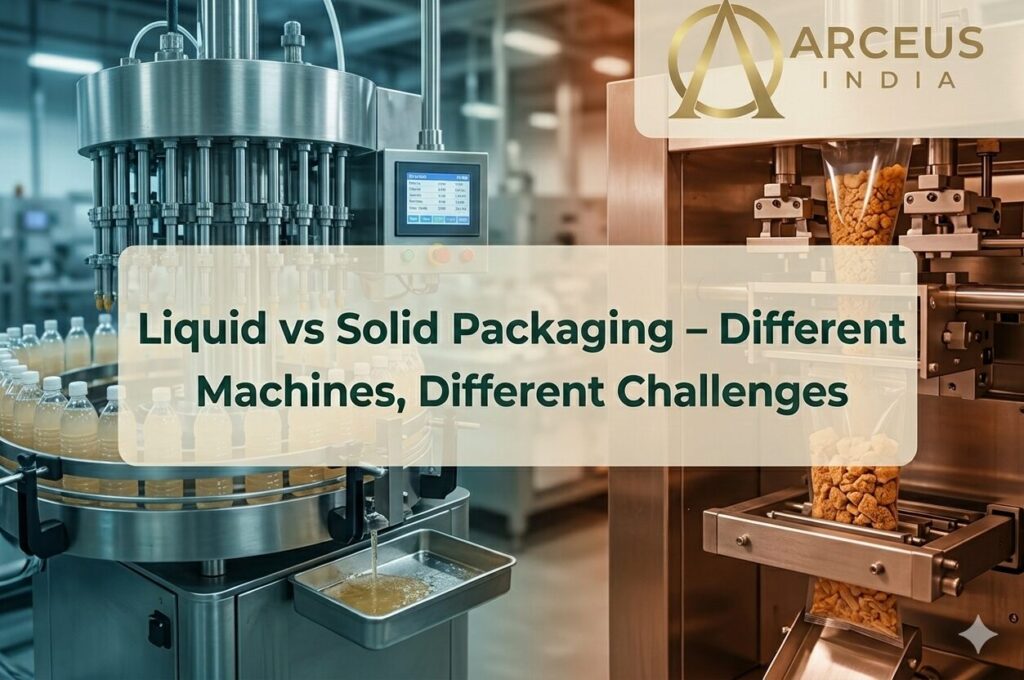
Packaging is no longer just the final step in production; it has become a critical function that directly impacts product quality, shelf life, logistics, and brand perception. As industries evolve, so do the complexities involved in packaging different types of products. One of the most important distinctions in modern manufacturing is liquid vs solid packaging, as each category demands unique technologies, processes, and precision levels. At Arceus India, the focus lies in understanding these differences deeply to deliver efficient, reliable, and scalable packaging solutions tailored to specific product needs.
Understanding the Basics of Liquid and Solid Packaging
Before diving into the technical challenges, it is essential to understand what is liquid packaging and what is packaging of solids. Liquid packaging refers to the process of enclosing fluid-based products such as oils, beverages, sauces, chemicals, and pharmaceuticals in containers that prevent leakage, contamination, and spoilage. These products require airtight sealing, precise volume control, and often specialized materials to maintain stability.
On the other hand, packaging of solids involves handling products like grains, powders, snacks, tablets, or industrial materials. These products may seem easier to manage, but they come with their own set of complexities, such as maintaining consistent weight, preventing breakage, and ensuring uniform filling.
The contrast between these two forms highlights why liquid vs solid packaging is not just a difference in material state but a distinction that defines the entire packaging strategy.
Types of Machinery Used in Liquid Packaging
When exploring what is liquid packaging, machinery becomes a critical component. Liquid packaging machines are designed to handle fluid dynamics, which means they must control flow, volume, and consistency simultaneously.
Common machines used in liquid packaging include bottle filling machines, pouch filling machines, and form-fill-seal systems. These machines often rely on technologies such as piston filling, gravity filling, or pump-based systems depending on the viscosity of the liquid. For example, thin liquids like water or juices can be filled using gravity fillers, while thicker substances like sauces or oils require piston fillers for accurate volume control.
Sealing is equally important in liquid packaging. Technologies such as heat sealing, induction sealing, and vacuum sealing are used to ensure that there is no leakage during storage or transportation. These machines are often integrated with automated cleaning systems to maintain hygiene standards, especially in food and pharmaceutical industries.
Machinery Used in Solid Packaging Systems
In comparison, machinery used for what is packaging of solids focuses more on weight accuracy, speed, and handling of different product forms. Solid packaging systems include vertical form-fill-seal machines, multi-head weighers, auger fillers, and counting machines.
For powders like flour or spices, auger fillers are commonly used as they can control the quantity precisely. For snack items such as chips or dry fruits, multi-head weighing systems ensure that each pack contains the correct weight while maintaining high speed. Tablet counting machines are widely used in pharmaceutical packaging to ensure exact counts in each bottle or strip.
Unlike liquid systems, the primary concern here is not leakage but maintaining consistency and avoiding product loss due to spillage, dust, or breakage. This difference highlights how liquid vs solid packaging requires completely different engineering approaches.
Real-World Applications of Liquid and Solid Packaging
Understanding liquid vs solid packaging becomes more practical when observed through real-world applications across industries. In the case of what is liquid packaging, industries such as beverages and FMCG rely on high-speed machines to package products like bottled water, juices, edible oils, sauces, shampoos, and pharmaceutical syrups, all of which require precise filling and leak-proof sealing to maintain product integrity.
At the same time, what is packaging of solids can be seen in products like rice, pulses, flour, snacks, and dry fruits, where automated weighing and sealing systems ensure consistency and efficiency. Pharmaceutical tablets and capsules are packaged using counting and blister machines, while industrial materials like cement and granules are packed using heavy-duty systems designed for bulk handling.
These examples clearly highlight how solid versus liquid packaging problems differ in nature, with liquids demanding control over flow and leakage, while solids require precision in weight, handling, and protection from breakage.
Key Operational Differences and Challenges
The discussion around liquid vs solid packaging would be incomplete without addressing the operational challenges. Liquids are inherently difficult to manage due to their flowing nature. Variations in viscosity, temperature, and foaming can lead to inconsistencies in filling. Leakage and contamination are major concerns, making sealing and hygiene critical factors.
On the other hand, what is packaging of solids presents challenges such as inconsistent flow, dust generation, and weight variations. Products may clump or stick, especially in humid conditions, affecting machine performance. Fragile items can break during high-speed operations, impacting product quality.
These solid versus liquid packaging problems highlight the need for specialized machinery and careful process design. A one-size-fits-all approach simply does not work when dealing with such fundamentally different product types.
At this stage, companies like Arceus India play a vital role in bridging the gap between operational challenges and technological solutions. By offering customized machinery and advanced automation, they enable businesses to optimize both liquid and solid packaging processes efficiently.
Automation and Technology in Modern Packaging
Modern advancements have significantly improved both liquid and solid packaging processes. Automation plays a key role in reducing human error, increasing speed, and maintaining consistency. Sensors, IoT-enabled systems, and AI-driven monitoring are now being integrated into packaging machinery.
In liquid vs solid packaging, automation helps in achieving precise control over filling, sealing, and quality checks. Smart systems can detect anomalies in real time, reducing wastage and downtime. This level of innovation is essential for businesses aiming to scale operations while maintaining high standards.
Choosing the Right Packaging Approach
Selecting between liquid and solid packaging systems is not just about the type of product but also about production goals, scalability, and cost efficiency. A clear understanding of what is liquid packaging and packaging of solids helps manufacturers make informed decisions.
Businesses must evaluate factors such as product characteristics, packaging materials, production volume, and regulatory requirements. Addressing solid versus liquid packaging problems at the planning stage can prevent costly errors and ensure smooth operations in the long run.
Ultimately, the choice of machinery and packaging strategy should align with the brand’s commitment to quality, efficiency, and innovation.